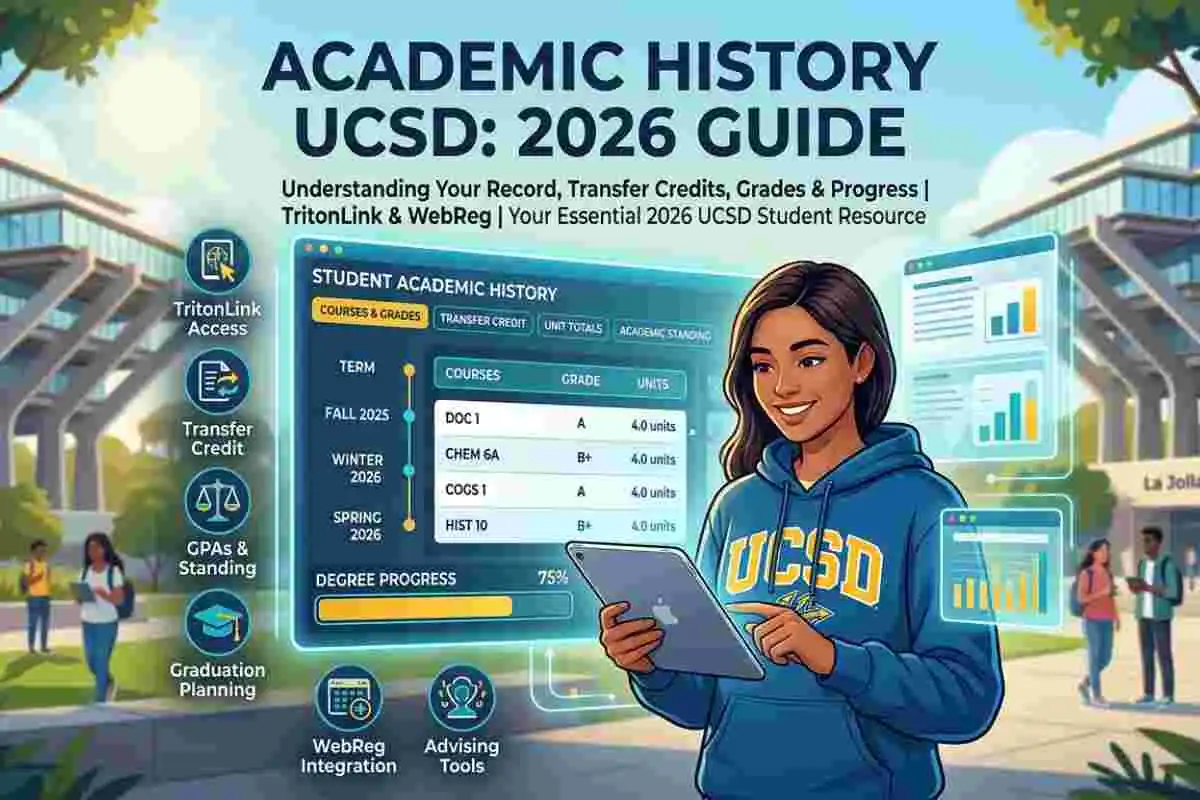
Understanding how UC San Diego stores, displays and reviews your academic record can save time and prevent costly mistakes during registration, graduation planning and transfer evaluations.
Many students search for terms such as “academic history ucsd,” “ucsd academic history tool,” and “ucsd tritonlink academic history” because they need a reliable way to verify coursework, grades, units and degree progress.
This guide explains what the Academic History tool does, how it connects with TritonLink and WebReg, what information it includes and where students often run into confusion.
| Category | Details |
|---|---|
| At a glance | The UCSD Academic History tool shows completed coursework, grades, units, transfer credit, AP/IB credit, and academic standing. Students typically access it through TritonLink and use it to confirm records before registration, advising, and graduation planning. |
| Primary use | Review courses, grades, units, and transfer credit |
| Access point | TritonLink student portal |
| Common searches | “webreg ucsd”, “ucsd academic history tool”, “academic history review ucsd” |
| Watch for | Processing delays, transfer-credit timing, and unofficial vs official transcript differences |
What Is the UCSD Academic History Tool?
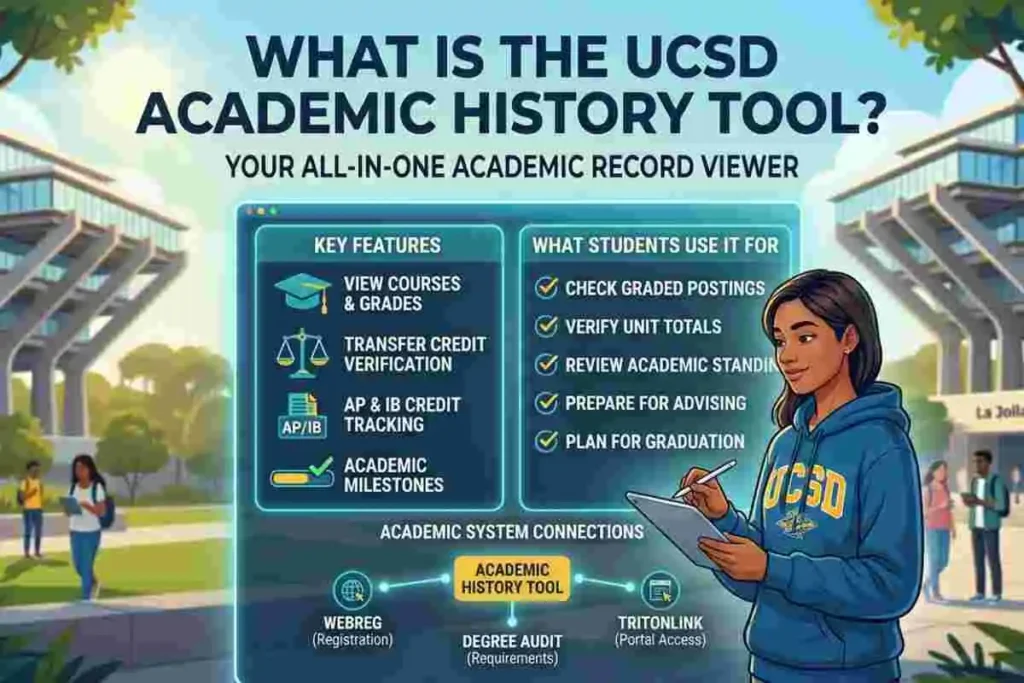
The Academic History tool at UC San Diego is an online record system that displays a student’s academic activity in one place. It functions as a detailed academic summary rather than a simple grade report.
Students can view courses completed at UCSD, grades earned, units accumulated, transfer credits, Advanced Placement (AP) or International Baccalaureate (IB) credit and other academic milestones that affect degree progress.
Although many students refer to it informally as the “UCSD transcript,” the tool is better understood as an academic record viewer. It provides a convenient way to review information without requesting an official transcript.
This is particularly useful during registration periods, advising appointments and graduation planning. Searches such as “ucsd academic history,” “academic history tool ucsd,” and “ucsd academic history tool” generally refer to this same system.
What students typically use it for
- Checking whether a course grade has been posted.
- Confirming transfer credit after admission.
- Verifying unit totals before enrollment.
- Reviewing academic standing or probation information.
- Preparing for advising or graduation review.
One reason the tool receives significant search traffic is that it sits at the intersection of several UCSD systems.
Students often move between WebReg for course registration, degree audit tools for requirement tracking and Academic History for official academic record review.
Understanding these connections helps reduce confusion when navigating UCSD’s student portals.
How Academic History Connects with TritonLink and WebReg
UCSD’s student services ecosystem includes multiple platforms that serve different purposes. The Academic History tool is commonly accessed through TritonLink, the university’s student portal.
When students search for “ucsd tritonlink academic history,” “academic history tritonlink ucsd,” or “academic history ucsd tritonlink,” they are usually looking for the Academic History page inside the TritonLink environment.
WebReg, by contrast, is primarily used for course registration. Searches such as webreg ucsd and “ucsd webreg academic history” often occur because students want to confirm prerequisites, completed courses, or unit totals before enrolling in classes.
While WebReg and Academic History are related, they are not identical systems. WebReg manages enrollment transactions, whereas Academic History displays the academic record that results from completed coursework.
A simplified view of the relationship
| System | Primary Purpose |
| TritonLink | Student portal and access hub |
| WebReg | Course registration and enrollment management |
| Academic History | Academic record review |
A common misunderstanding is that changes made in WebReg appear instantly in Academic History.
In reality, Academic History generally reflects completed academic transactions after university processing cycles.
During registration periods, temporary discrepancies can occur between what students see in WebReg and what appears in their academic record.
Key Features of the UCSD Academic History Tool
The Academic History system offers more than a list of grades. Its value comes from consolidating academic information that students would otherwise need to gather from multiple sources.
This is why terms such as “my academic history ucsd” and “online academic history tool ucsd” are frequently searched by current and former students.
Key features include
- Course history with term-by-term records.
- Grades earned in completed courses.
- Unit totals and cumulative progress.
- Transfer credit evaluations.
- AP, IB and other examination credit.
- Academic standing information.
- Degree-related academic milestones.
For students planning graduation, the most important feature is often the cumulative unit summary. This allows them to verify whether they are approaching the university’s minimum unit requirements.
Transfer students frequently rely on the transfer credit section to confirm that previously completed coursework has been properly evaluated.
Another useful aspect is historical record access. Students can review coursework from prior years without requesting archived records. This becomes particularly valuable when applying to graduate programs, internships, or professional schools that require accurate reporting of completed coursework.
Accessing and Reviewing Your Academic History
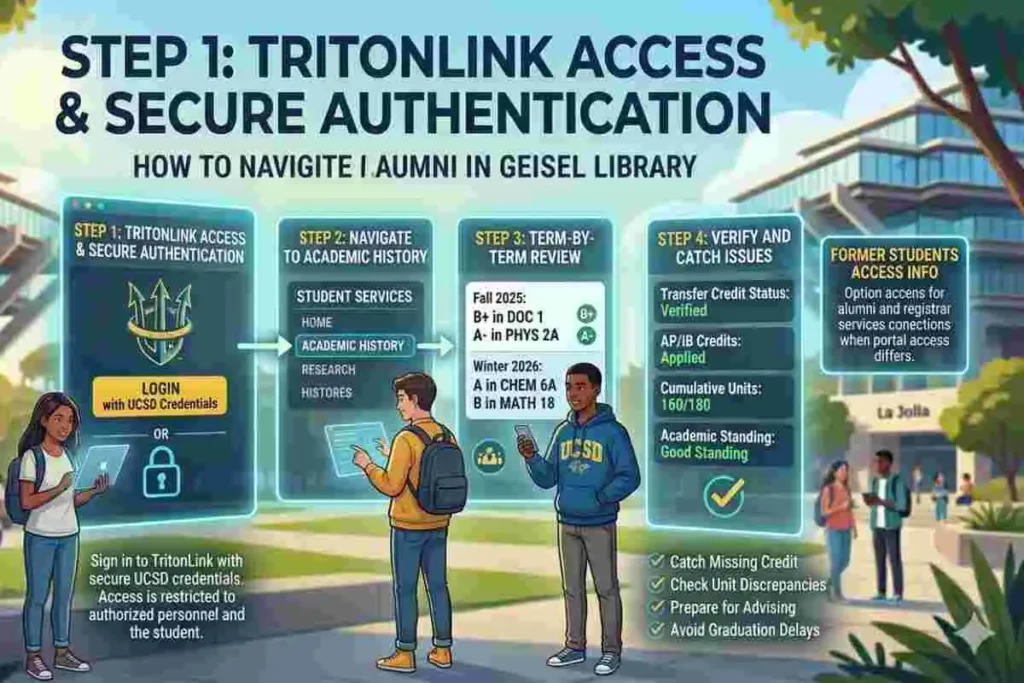
Access typically begins through the TritonLink portal. After authentication with UCSD credentials, students can navigate to the Academic History section and view their records.
Because the system contains sensitive educational information, access is generally restricted to the student and authorized university personnel.
Typical review process
- Sign in to TritonLink with UCSD credentials.
- Open the Academic History section from the student services menu.
- Review term-by-term coursework and grades.
- Verify transfer credit and examination credit entries.
- Check cumulative units and academic standing.
Students often perform an “academic history review ucsd” before important deadlines such as graduation applications or major changes.
This review helps identify missing transfer credit, incorrect course postings, or discrepancies in unit totals. Catching issues early is important because corrections may require departmental or registrar processing time.
For former students, access may differ depending on account status. Searches such as “former students ucsd academic history” reflect the need to retrieve past academic information after graduation or separation from the university.
In some cases, former students may need to use alumni or registrar services if standard student portal access is no longer available.
Benefits and Common Challenges
The Academic History tool provides significant convenience by centralizing academic records. Students no longer need to rely solely on printed transcripts or departmental records to verify coursework.
Advising appointments become more productive when both the student and advisor can review the same up-to-date academic information.
Benefits
- Centralized academic record access.
- Quick verification of grades and units.
- Improved preparation for advising sessions.
- Support for graduation planning.
- Easier tracking of transfer credit.
However, students should also understand the system’s limitations. Academic History is not always a real-time reflection of every academic transaction.
Processing delays can occur after grade submission, transfer credit evaluation, or administrative updates.
During busy registration periods, students may notice temporary differences between WebReg information and Academic History records.
Common challenges
- Delays in posting grades or transfer credit.
- Confusion between WebReg and Academic History functions.
- Difficulty accessing records after leaving the university.
- Misunderstanding unofficial records versus official transcripts.
A skeptical review of the system highlights an important point: many student frustrations arise not from missing data but from expectations about timing.
Universities process academic records through multiple administrative systems and updates may not appear instantly across all platforms.
Academic Advising and Departmental Use
Academic advisors frequently use Academic History during student consultations. In departments such as History, advisors may review completed coursework, major requirements and unit progress when helping students plan future schedules.
Searches related to “history department academic advising ucsd” often overlap with Academic History because advisors rely on the student’s academic record to provide accurate guidance.
The tool is especially valuable when students are considering major changes, minors, study abroad programs, or graduation timelines.
Advisors can identify prerequisite completion, repeated courses and unit accumulation patterns that affect academic planning. This creates a shared reference point for both the student and the advising office.
One important distinction is that Academic History shows what has been completed, while degree audit systems focus on how completed coursework applies to specific requirements.
Students sometimes assume that every course listed in Academic History automatically satisfies a major requirement, but departmental policies and curriculum rules may determine how courses are applied.
For students in the History Department, advising conversations often involve both academic history records and degree requirement evaluations. Understanding this difference can prevent confusion during academic planning discussions.
Best Practices for Managing Your UCSD Academic Record
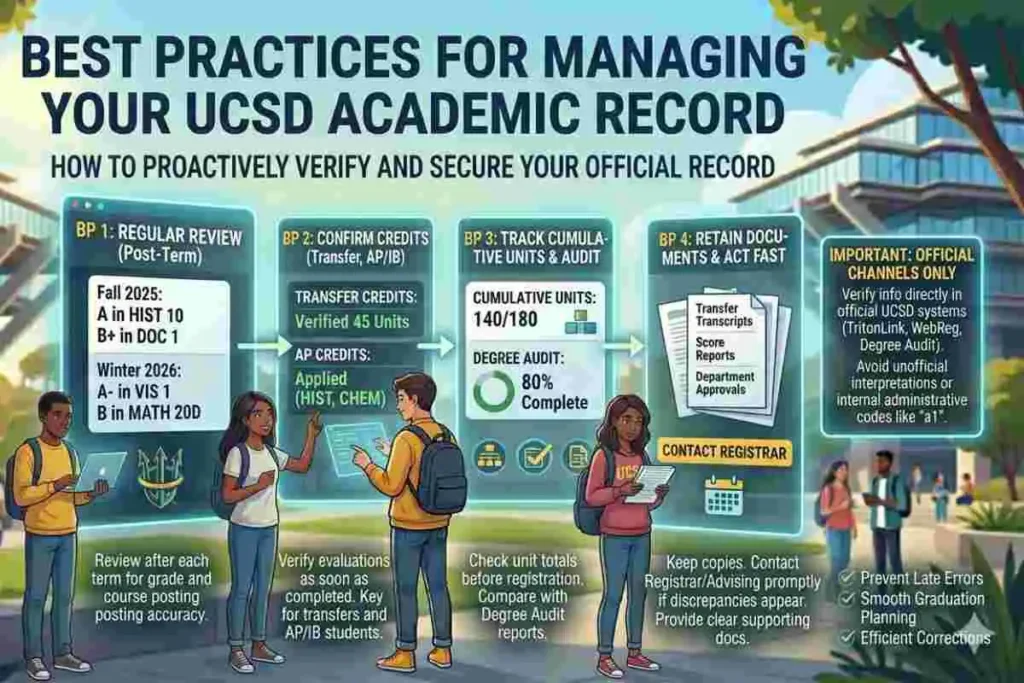
Students can avoid many common problems by reviewing their academic history regularly. Waiting until graduation to verify records increases the risk of discovering errors too late for easy correction.
A proactive approach is especially important for transfer students, double majors and students using AP or IB credit.
Best practices
- Review your record after each academic term.
- Verify transfer credit as soon as evaluations are completed.
- Check cumulative units before registration periods.
- Compare Academic History with degree audit reports.
- Keep copies of important academic documents.
- Contact the Registrar or advising office promptly if discrepancies appear.
Students searching for “a1 ucsd academic history” sometimes encounter references to administrative categories or internal labels.
Regardless of terminology, the safest approach is to verify information directly within the official UCSD systems rather than relying on unofficial interpretations.
When requesting corrections, students should be prepared to provide supporting documentation such as transfer transcripts, examination score reports, or departmental approvals. Clear documentation helps university staff resolve record issues more efficiently.
Conclusion
The UCSD Academic History tool is a central resource for reviewing coursework, grades, units, transfer credit and academic standing.
By connecting with TritonLink and complementing WebReg and advising systems, it helps students manage their academic progress more effectively.
Understanding its capabilities and limitations is important, especially when verifying graduation requirements or transfer evaluations.
Regular review, early correction of discrepancies and consultation with advisors remain the best strategies for maintaining an accurate academic record.
FAQ’s
What is the difference between UCSD Academic History and an official transcript?
UCSD Academic History is an online record that lets students view their courses, grades, units and academic progress. An official transcript contains similar information but is a certified university document that may be required for jobs, graduate school applications, or other official purposes.
Can former students access their UCSD Academic History?
Some former students may still access their records through TritonLink, depending on their account status. If portal access is unavailable, they can usually obtain academic records or transcripts through UCSD Registrar services.
Why does my WebReg information not always match my Academic History?
WebReg is designed for course registration, while Academic History shows completed and processed academic records. Differences can occur when grades, transfer credits, or other updates are still being processed by the university.
How often should I review my UCSD Academic History?
Students should review their Academic History at least once each term and before important events such as registration, graduation applications, or advising appointments. Regular checks help identify errors or missing credits early.
Does Academic History show transfer and AP/IB credit?
Yes, Academic History typically includes approved transfer coursework, AP credit, IB credit and other accepted examination credits. These records contribute to unit totals and overall academic progress.
Is the Academic History tool enough for graduation planning?
The tool is helpful for tracking completed courses and units, but students should also review degree audits and consult academic advisors. Graduation requirements are often determined by additional departmental and university policies.