
If you’re searching for contact g15tools com, you probably want the quickest way to reach the G15Tools team.
Whether you have a question about one of their articles, want to report an issue or need help with a tool or guide, the best option is to use the official contact page or support email.
After reviewing how G15Tools handles user inquiries, it’s clear that providing specific details, such as the article title, page URL or screenshots, can make it easier for the support team to understand your request.
In this guide, you’ll learn the available contact methods, when to use each one, what information to include and what to do if you don’t receive a response.
What Does Contact G15Tools Com Mean?
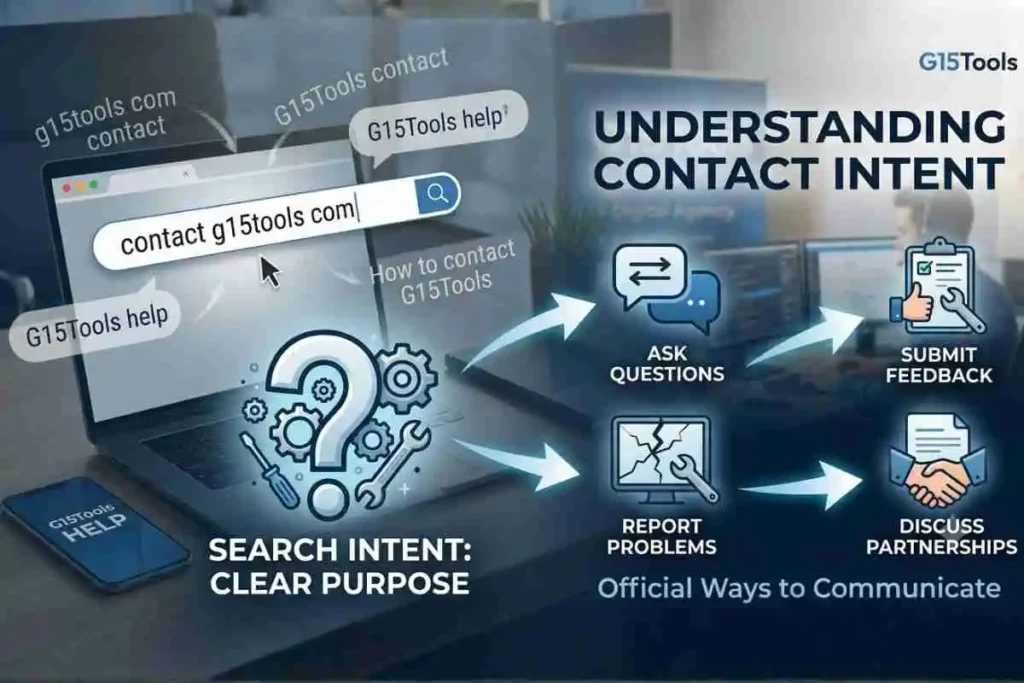
The phrase contact g15tools com refers to finding the official ways to communicate with the team behind G15Tools. Many users search for this phrase after reading an article on the website or using one of its online resources.
Unlike informational searches that seek product reviews or buying guides, this search has a clear purpose. People want to know how they can ask questions, report problems, submit feedback or discuss partnerships with the website.
The search may also appear in slightly different forms, including:
- g15tools com contact
- G15Tools contact
- G15Tools support
- How to contact G15Tools
- G15Tools customer support
- G15Tools help
Although the wording varies, the search intent remains the same: finding the official communication channels.
What Are G15Tools?
G15Tools is an online platform that publishes content related to tools, technology, equipment, buying guides, product reviews and practical recommendations. Visitors often use the website to compare products, learn about new tools and make informed purchasing decisions.
Because readers rely on the platform for information, it’s natural that they occasionally need assistance. Common situations include asking follow-up questions about a guide, reporting outdated information or requesting clarification before making a purchase decision.
Official Ways to Contact G15Tools
The best communication method depends on the type of inquiry you have. Some requests require detailed explanations, while others can be resolved quickly through a simple message.
The following table provides an overview of the most common contact options.
| Contact Method | Best For | Typical Use |
| Support Email | Detailed questions, bug reports, collaborations | Sending documents, screenshots and complete explanations |
| Contact Form | General inquiries | Asking questions directly through the website |
| Live Chat (if available) | Quick assistance | Simple questions requiring immediate guidance |
| Social Media | General engagement | Following updates and sending public or private messages |
Whenever possible, use the official communication channels listed on the G15Tools website instead of relying on unofficial third-party sources.
Using the Official Contact Form
For many visitors, the website’s contact form is the easiest way to communicate with G15Tools.
Instead of opening an email application, users simply enter their name, email address and message before submitting the request.
This method works well for general questions, including:
- Questions about published articles
- Suggestions for future content
- Reporting minor website issues
- General feedback
- Requests for clarification
Before submitting the form, review your message carefully. A valid email address is essential because it’s typically the only way the support team can reply.
Contacting G15Tools by Email
Email is generally the preferred option for inquiries that require more detail.
Unlike a contact form, email allows users to provide complete explanations, attach screenshots, include links and organize information clearly. This is especially helpful when reporting technical issues or requesting support for a specific article.
A well-written email should include:
- A clear subject line
- Your name
- A detailed explanation of the issue
- The relevant article title or page URL
- Any error messages you encountered
- Screenshots, if applicable
Providing complete information in your first message reduces unnecessary back-and-forth communication and helps the support team understand your request more quickly.
When Should You Use Email Instead of the Contact Form?
Although both methods serve similar purposes, email is usually the better choice when your inquiry involves multiple details.
For example, email is recommended when:
- You need to attach screenshots.
- You’re reporting a technical problem.
- You’re requesting a correction to published information.
- You have questions about partnerships or collaborations.
- Your message requires several paragraphs of explanation.
The contact form, on the other hand, is better suited for straightforward questions that don’t require attachments.
Is Live Chat Available?
Some users search for live chat because they want immediate assistance. If G15Tools offers a live chat feature, it is typically intended for quick questions rather than complex technical discussions.
Live chat can be useful when you need clarification about website navigation, published content or general information.
However, if your inquiry involves troubleshooting, multiple screenshots or detailed explanations, email usually remains the more practical option.
Always check the official website to see whether live chat is currently available, as website features can change over time.
Can You Contact G15Tools Through Social Media?
Many websites maintain social media profiles to share updates, publish new content and interact with readers.
If G15Tools has active social media accounts, these platforms can be useful for:
- Following new articles
- Asking simple questions
- Sharing feedback
- Participating in discussions
- Learning about website updates
However, social media should not replace official support channels for technical issues or private account-related matters.
For sensitive inquiries, email or the contact form remains the preferred option because it allows private communication and provides more space for detailed explanations.
Common Reasons People Contact G15Tools
Visitors contact G15Tools for many different reasons. Some simply want clarification about a buying guide, while others need assistance with technical problems.
The most common reasons include:
| Reason | Explanation |
| Technical Issues | Reporting broken pages, loading errors or website problems |
| Content Questions | Requesting clarification about an article or review |
| Feedback | Suggesting improvements or sharing opinions |
| Error Reports | Pointing out incorrect information or outdated content |
| Business Inquiries | Discussing advertising, partnerships or collaborations |
| Feature Suggestions | Recommending new topics or website improvements |
Providing complete information about your request helps ensure it reaches the appropriate team and can be addressed more efficiently.
How Long Does It Usually Take to Receive a Response?
Response times vary depending on several factors, including the complexity of your request, weekends, public holidays and the number of inquiries currently being handled.
Simple questions may receive replies relatively quickly, while technical investigations or partnership discussions often require additional review.
If you haven’t received a response after a reasonable waiting period, check your spam or junk folder first. Automated replies and legitimate support emails occasionally end up there by mistake.
If no response is found, sending a polite follow-up message that references your original inquiry is generally the most appropriate next step.
How to Write a Support Request That Gets Better Results
One of the biggest reasons support requests take longer than expected is the lack of useful information. A short message like “Your website isn’t working” doesn’t give the support team enough context to identify the problem.
Instead, explain exactly what happened. Mention the page you were visiting, the action you were trying to complete and any error message that appeared. If the issue is related to a specific article, include its title or URL. Adding screenshots can also help the team understand the problem without asking for additional details.
A well-organized request is easier to investigate and often leads to a faster resolution.
Information Worth Including
While every inquiry is different, these details are generally helpful:
| Information | Why It Helps |
| Article title or page URL | Identifies the exact content you’re referring to |
| Device type | Helps determine whether the issue is device-specific |
| Browser name and version | Useful for troubleshooting compatibility problems |
| Screenshot | Provides visual confirmation of the issue |
| Error message | Makes technical investigations more accurate |
| Steps you’ve already tried | Prevents duplicate troubleshooting suggestions |
Including these details in your first message can significantly reduce unnecessary follow-up questions.
What If the Contact Form Isn’t Working?
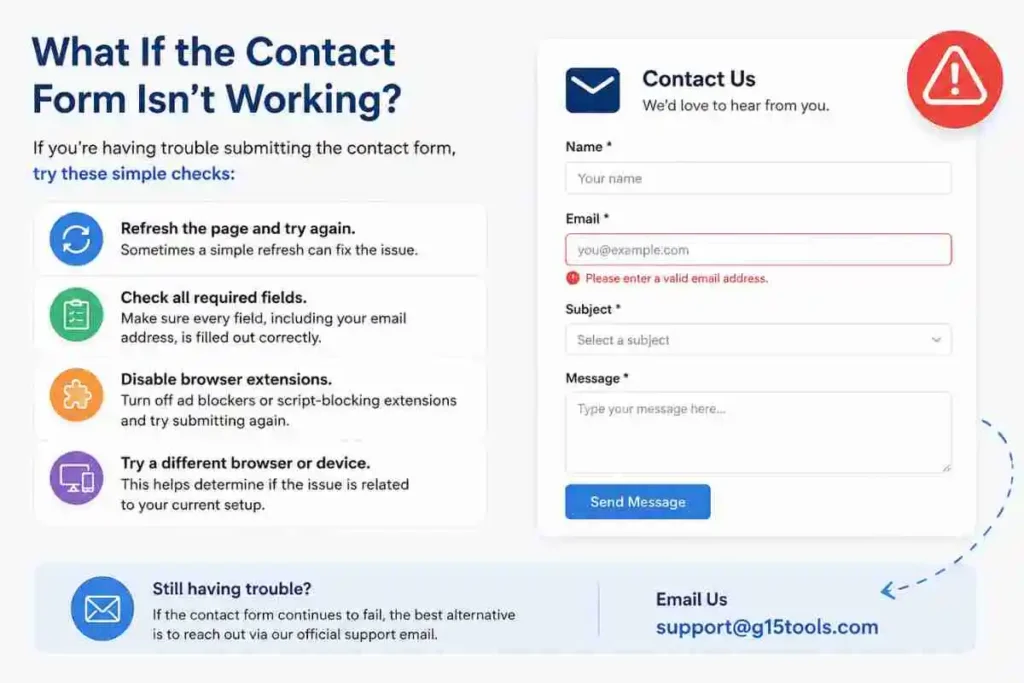
Occasionally, visitors may experience issues when submitting an online contact form. This doesn’t always mean there’s a problem with the website itself. Browser settings, internet connectivity or temporary technical issues can also prevent successful submission.
If the form isn’t working, start with a few simple checks. Refresh the page and try again. Make sure every required field has been completed correctly, including your email address.
If you’re using browser extensions that block scripts or advertisements, temporarily disable them and test the form again. Trying a different browser or device can also help determine whether the issue is related to your current setup.
If the contact form continues to fail after these steps, using the official support email is usually the best alternative.
What to Do If You Don’t Receive a Reply
Waiting for a response can be frustrating, especially if your question is time-sensitive. However, sending multiple messages within a short period usually doesn’t speed up the process.
Instead, allow a reasonable amount of time for the team to review your inquiry. Check your spam or junk folder, as legitimate replies are sometimes filtered incorrectly by email providers.
If you still haven’t received a response after waiting, send a polite follow-up message. Reference your original inquiry rather than creating a completely new request. This helps keep the conversation organized and makes it easier for the support team to locate your previous message.
Can Businesses Contact G15Tools?
Yes. Businesses, manufacturers, agencies and content creators may contact G15Tools regarding potential collaborations or professional opportunities.
Business inquiries often differ from general support requests because they usually involve advertising proposals, sponsored content discussions, product reviews, media requests or long-term partnerships.
To improve the chances of receiving a meaningful response, introduce your company clearly and explain the purpose of your inquiry. Include relevant background information, your website and the specific collaboration you have in mind rather than sending a generic proposal.
Professional communication is more likely to receive careful consideration than vague outreach emails.
Can You Suggest New Content or Report Incorrect Information?
Constructive feedback helps any informational website improve over time. If you notice outdated information, broken links, formatting issues or factual errors, reporting them responsibly can benefit future readers.
Similarly, if there’s a topic you’d like to see covered, you can submit a content suggestion through the available contact channels.
When reporting an issue, explain exactly what appears incorrect and, if possible, provide supporting information or references. Specific feedback is much easier to verify than general statements.
Is It Safe to Share Personal Information?
When contacting any website, it’s important to protect your privacy. Only provide information that’s necessary to resolve your inquiry. For example, your name, email address, screenshots or page links may be appropriate.
However, you should never include sensitive information such as passwords, banking details, credit card numbers, verification codes or government-issued identification unless you’re communicating through a verified and secure process that specifically requires it. Being cautious with personal information reduces the risk of fraud or identity theft.
How to Verify You’re Contacting the Official G15Tools Website
Before submitting personal information, take a moment to verify that you’re communicating through the official website.
Start by checking the website address carefully. Fraudulent websites sometimes use similar-looking domain names designed to imitate legitimate platforms. Make sure the URL is spelled correctly and that you’re visiting the genuine G15Tools domain.
If you’re following a link from social media or another website, confirm that it leads to the official contact page before submitting your information.
This simple step helps protect you from phishing attempts and fake support pages.
Common Mistakes to Avoid
Many support requests become unnecessarily delayed because of avoidable mistakes.
One common mistake is sending multiple emails about the same issue within a short period. This can create duplicate support tickets and make communication more difficult to manage.
Another mistake is writing overly brief messages without explaining the problem. While it’s good to keep your email concise, it should still include enough information for someone else to understand the issue.
Some users also forget to include their contact details or accidentally type an incorrect email address. If the support team cannot reply, your issue may remain unresolved.
Taking a few extra minutes to review your message before sending it often saves time later.
Best Practices Before Contacting G15Tools
Reaching out to support is often the fastest way to resolve a problem, but spending a few minutes gathering the right information beforehand can make the process much smoother.
Start by checking whether your question has already been answered on the website. Many informational websites publish detailed buying guides, tutorials and frequently asked questions that address common concerns. Using the website’s search function may save you from waiting for a response.
If you still need assistance, prepare your message carefully. Explain the issue in chronological order, include any relevant page links and describe the steps you’ve already taken. This helps the support team understand your situation immediately rather than asking for additional clarification.
It’s also worth reviewing your message before sending it. Correcting spelling mistakes, confirming your email address and ensuring that any attached screenshots are relevant can prevent unnecessary delays.
Email vs Contact Form: Which Is Better?
Both communication methods have advantages and the best choice depends on your situation.
| Feature | Contact Form | |
| Best for detailed explanations | ✔ | Limited |
| Supports file attachments | Usually Yes | Depends on the website |
| Good for quick questions | ✔ | ✔ |
| Suitable for partnership inquiries | ✔ | Sometimes |
| Easy to use on mobile devices | ✔ | ✔ |
For technical problems or business discussions, email is generally the better option because it allows you to organize information more effectively. For routine questions or general feedback, the contact form is usually sufficient.
Signs That Your Support Request Is Well Written
A good support request isn’t necessarily long. Instead, it’s complete, clear and focused.
An effective message usually:
- Explains one issue at a time.
- Includes relevant page links or article titles.
- Describes what happened before the problem occurred.
- Mentions any troubleshooting already attempted.
- Uses a professional and respectful tone.
- Avoids unnecessary repetition.
Support teams can often resolve clear requests much faster than vague ones.
Common Misconceptions About Contacting G15Tools
Several misunderstandings can create unrealistic expectations.
One common misconception is that every message receives an immediate response. In reality, response times depend on factors such as inquiry volume, weekends, holidays and the complexity of the request.
Another misconception is that social media always provides faster support. While social platforms are useful for community engagement, they are not always monitored as closely as official support channels. Sensitive or technical issues are generally better handled through email or the official contact page.
Some users also assume that submitting the same request multiple times will increase its priority. In practice, duplicate submissions may actually slow down the support process because they create unnecessary duplicate conversations.
Expert Tips for Getting Faster Assistance
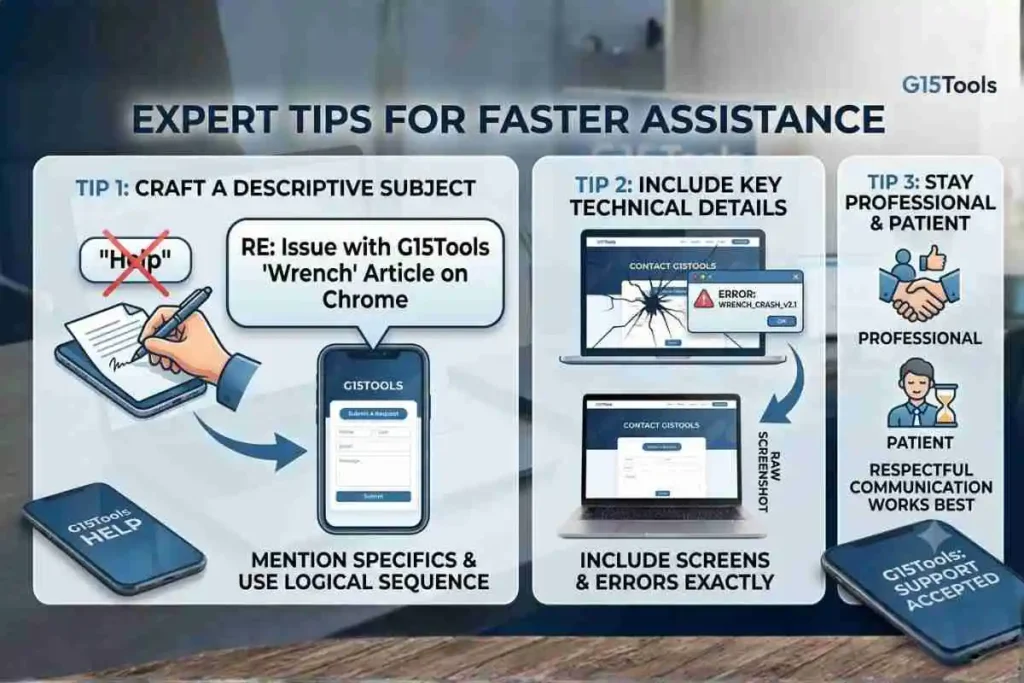
Although no one can guarantee an immediate response, a few simple practices can improve your chances of receiving helpful assistance.
Use a descriptive subject line that summarizes your issue instead of writing something generic like “Help.” Mention the specific article, tool or page involved and explain your problem in a logical sequence.
If you’re reporting a technical issue, include screenshots and any error messages exactly as they appear. Avoid editing screenshots in ways that hide important information.
Keep your message professional and patient. Respectful communication encourages productive conversations and makes it easier for the support team to understand your request.
Final Thoughts
Searching for contact g15tools com usually means you need a reliable way to communicate with the G15Tools team.
Whether your goal is to ask a question, report an issue, provide feedback or discuss a business opportunity, using the appropriate contact channel can make the process much more efficient.
Before reaching out, gather the relevant details, verify that you’re using the official website and clearly explain your request.
A thoughtful message not only improves the quality of the response but also helps the support team resolve your inquiry more effectively.
If you don’t receive an immediate reply, remain patient, check your spam folder and follow up politely after allowing a reasonable amount of time.
Following these best practices will give you the best chance of receiving accurate and useful assistance.
FAQ’s
Can I contact G15Tools to report a broken article or outdated information?
Yes. If you discover inaccurate details, broken links or outdated recommendations, you can notify the G15Tools team through their official contact channel. Including the page URL and explaining the issue clearly will make it easier for them to review your report.
What should I do if I accidentally submitted incorrect information in the contact form?
If you realize you’ve entered the wrong email address or omitted important details, send a new message with the corrected information. Clearly mention that it replaces your previous submission to avoid confusion.
Is it appropriate to request product recommendations through G15Tools contact?
Yes, provided your question relates to topics covered on the website. Being specific about your requirements, budget or intended use will help the team understand what you’re looking for.
Can I contact G15Tools from any country?
Generally, yes. Since communication is handled online, users from different regions can usually submit inquiries through the official website or available support channels. Keep in mind that response times may vary depending on business hours and time zone differences.
Should I include screenshots when reporting a technical problem?
Whenever possible, yes. Screenshots often help explain problems much faster than text alone. Make sure they clearly show the issue while avoiding the inclusion of sensitive personal information.
How can I tell whether I’ve reached the official G15Tools contact page?
Always verify the website address before submitting personal information. Avoid relying solely on third-party websites or unofficial links and confirm that you’re using the genuine G15Tools domain.