Ask ten people what smart home or AI-powered means and you’ll get ten answers borrowed from marketing copy. The gap between promise and delivery is wide enough that plenty of people bought in once, were disappointed, and wrote off the category. That instinct made sense three years ago. It makes less sense now.
Ai Is Three Things Wearing One Name
Pattern recognition is the oldest and most reliable: a camera separating a delivery driver from a cat, a watch flagging an irregular heart rhythm. Small models, usually on-device, and it mostly just works.
Prediction learns your habits, like a thermostat figuring out you leave at eight. It works with enough history and feels stupid without it, which is why the first two weeks with a learning thermostat are worse than the next two years.
Generative AI is the newest layer, being retrofitted into everything. It lets you say turn everything off downstairs except the kitchen instead of tapping six toggles. More flexible, but slower, usually cloud-dependent, occasionally wrong, and increasingly behind a subscription.
Which kind you’re buying tells you what happens when the internet drops. The first two keep working. The third usually doesn’t.
Smart Homes: The Boring Standard Finally Matters
The early smart home was a remote control with extra steps. Two things changed.
Value moved from control to automation the house doing the right thing unasked. Lights at dusk. Heating down when the last person leaves. A leak sensor closing the water main before the floor is destroyed. The point isn’t convenience, it’s removing a decision you’d otherwise have to remember.
Interoperability arrived Matter lets certified devices describe themselves, pair securely, and work across Apple Home, Google Home, Alexa, SmartThings and Home Assistant. Thread is a separate low-power mesh network for battery devices like sensors, locks and buttons; since Matter also runs over Wi-Fi and Ethernet, a Matter device isn’t automatically a Thread device. That trips up a lot of buyers.
Matter 1.6, released June 2026, added NFC commissioning that works before a device has power, cross-ecosystem sharing called Joint Fabric, and updated security certification. Versions 1.5 and 1.5.1 were the significant ones for cameras, doorbells and energy management, turning smart plugs and appliances from switches into grid participants that respond to pricing schedules.
The caveat: certification and implementation aren’t the same. Ecosystems implement the spec inconsistently and opaquely, with SmartThings moving fast while others lag, and vendors rarely publishing which features they support.
Certification confirms the base standard; automation triggers and energy dashboards depend on each app. Buy Matter-certified as a floor, not a guarantee, and test the one workflow you care about before buying eight of something.
Starting from nothing? Lighting in your two or three main rooms, then a thermostat, then cheap water/smoke/door sensors, then a doorbell or camera, then locks. Voice assistants and displays are the most visible part of the category and the least necessary an interface, not a function.
Wearables: The Category That Quietly Delivered
The wrist segment has matured while smart rings and glasses are the fastest-growing categories from a small base, and the whole sector is shifting from fitness gadget to clinical companion. One surprise: earwear, not smartwatches, is the largest wearable segment by volume.
Rings grew for a physiological reason, not a fashion one. The finger gives cleaner readings, making rings better for sleep, resting heart rate and HRV; watches stay better for workouts, GPS, live heart rate and ECG. Serious trackers wear both ring overnight, watch by day.
At CES 2026 the emphasis moved from new sensors to endurance and battery life, from screen-heavy wrist computers toward compact AI-driven devices, with rings adding voice notes and transcription. The value now sits in software intelligence, not hardware.
The limits. Wearables are good at trends, poor at absolute precision. Sleep figures to the minute are estimates. Calorie numbers are rough. Accuracy varies across user groups, an under-discussed weakness in the research. Continuous glucose monitoring has reached consumers but remains a dedicated medical device, not a watch feature.
Cuffless blood pressure is still an estimation problem. Smart glasses are about AR, navigation and communication; real health sensing there is years out. Treat the numbers as a prompt to pay attention, not a diagnosis.
The Loop That Makes All Three Worth It
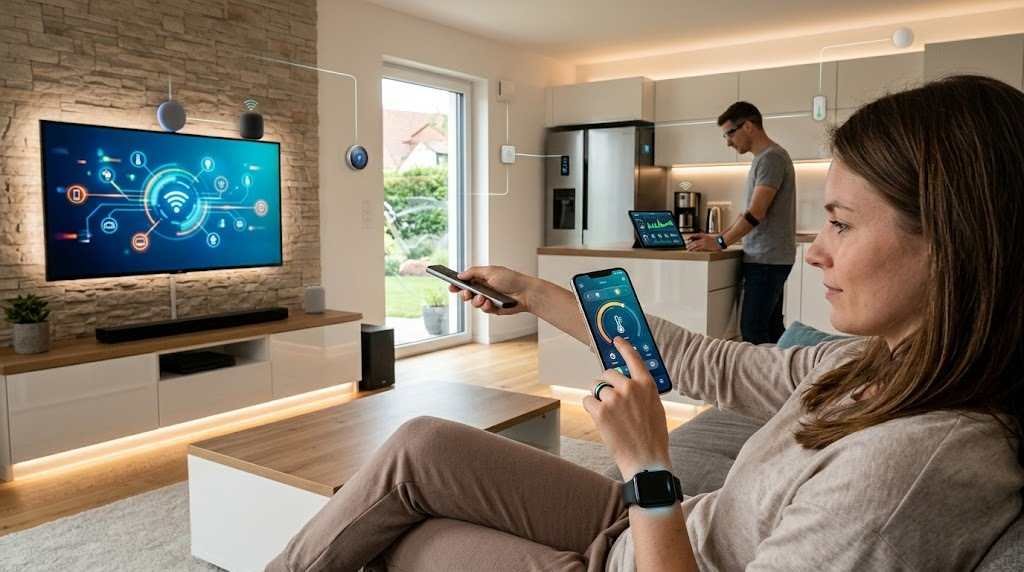
A wearable knows your physiological state. A smart home controls your environment. AI translates a reading into an action. If your sleep data shows you overheat at three in the morning, the thermostat drops the bedroom before it happens. If your watch registers you’re genuinely awake, the morning routine starts then rather than at an alarm you snoozed twice.
The most underrated case is presence. The commonest smart home failure is a house that doesn’t know whether anyone’s in it lights going off while you’re sitting there, heating running for an empty building. A wearable answers that better than a phone, because you don’t leave your watch on the kitchen counter.
Generative AI sits on top as the authoring tool: describe the behaviour instead of building rules in a clunky editor. A real accessibility gain, still inconsistent enough that experienced users keep hand-built rules as a fallback.
Four Checks Before You Buy
Where processing happens. These devices generate continuous, intimate data location, sleep, who’s at your door, when the house is empty. On-device versus cloud is the most meaningful privacy differentiator. Check retention and onward sharing of health data.
The subscription maths. Camera storage, advanced health analytics and AI assistants are all moving behind monthly fees, and pricing diverges sharply within a category: the Oura Ring 4 is $349 plus a premium tier, Samsung’s Galaxy Ring roughly $399 with no mandatory subscription. Compare three-year costs, not sticker prices.
What happens when the company leaves. Cloud-dependent hardware has a long history of being bricked after a shutdown or acquisition. Local control keeps working when servers don’t the strongest argument for Matter, Thread and Home Assistant.
Whether it solves a real problem. A connected toaster answers a question nobody asked. What does it do offline, and does the automation save you anything you’d notice?
Conclusion:
AI turns data into decisions. Smart homes finally have a standard worth building on, though implementation lags the spec. Wearables are the most mature of the three and the best source of the personal signal that makes the other two intelligent rather than merely remote-controlled.
Buy for the problem, not the ecosystem you’re promised. Favour local control, run the subscription numbers, start with three devices instead of thirty. The goal isn’t a house that can do everything it’s a house that quietly does the right thing.
REALATED ITEMS: WhatsonTech